The Empire of Ghana
The first Ghana was not on this coast. From around the fourth century, the Soninke people built a state across what is now southeastern Mauritania and western Mali, grown wealthy on the trade routes carrying gold north across the Sahara and salt south in return.
‘Ghana’ was not originally the name of the country at all. It was the title of its ruler — warrior king — in the Soninke language, still spoken by around two million people today. Traders and neighbours heard the title, applied it to the whole territory, and the name stuck. The empire weakened from the eleventh century under pressure from the north and was eventually absorbed into the rising Mali Empire.
Gold, and the arrival of Europeans
Portuguese ships reached this coast in 1471 and found people wearing worked gold. Within a decade they had begun building in stone: Elmina Castle went up in 1482, the first European fortification of its size in sub-Saharan Africa and the anchor of a trade in gold, ivory and timber.
The Dutch, English, Danes, Swedes and Brandenburgers followed, and the shoreline filled with forts — more than thirty of them along a few hundred kilometres, each holding a stretch of coast against European rivals as much as against anyone else. The stretch became known in Europe simply as the Gold Coast. Many of those forts are still standing and can be visited.
The Atlantic slave trade
From the sixteenth century the traffic shifted from goods to people, and by the 1600s the trade in captives had overtaken gold entirely. The same forts were rebuilt around it. Dungeons were cut beneath the courtyards of Cape Coast Castle and Elmina Castle, where people were held, sometimes for months, before being taken through a seaward doorway to waiting ships.
Millions of West Africans were carried across the Atlantic over the course of the trade. Both castles are UNESCO World Heritage Sites today and are kept as memorials as much as monuments; the guides who work in them are trained by the Ghana Museums and Monuments Board.
The Asante and the wars of resistance
Inland, a different power was consolidating. Around 1701 the Asante state was formed at Kumasi under Osei Tutu, unifying Akan groups around the Golden Stool, the sacred object held to embody the soul of the nation. At its height the Asante Empire controlled much of present-day Ghana and traded directly with the Europeans on the coast.
That brought a century of conflict with Britain. The last of these wars began in 1900, when the British governor demanded to sit on the Golden Stool. Yaa Asantewaa, queen mother of Ejisu, led the Asante into what became known as the War of the Golden Stool. The rising was defeated and Asante was annexed, but the stool itself was never surrendered.
Abolition and the Gold Coast colony
Britain outlawed the slave trade across its empire with the Slave Trade Act of 1807. The act ended British participation in the traffic rather than the institution of slavery itself, and the trade continued under other flags for decades afterwards.
In 1874 Britain formally declared the territory a Crown colony under the name Gold Coast. Cocoa, introduced late in the nineteenth century, grew into the colony’s dominant export and remains central to the Ghanaian economy.
Independence, 1957
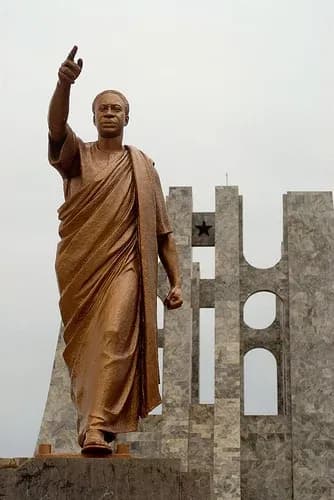
On 6 March 1957 the Gold Coast became the first colony in sub-Saharan Africa to win independence, with Kwame Nkrumah, who had led the campaign, as prime minister. Nkrumah understood the moment as continental rather than national. “Our independence is meaningless,” he said, “unless it is linked up with the total liberation of Africa.”
More than thirty African countries became independent over the following decade. Ghana became a republic in 1960 with Nkrumah as its first president.
A name, a flag, a currency
The new country took the name of the medieval empire, on the understanding that many of its people descended from those who had lived there. The flag, designed by Theodosia Okoh, carries the Pan-African red, gold and green with a black star at its centre — a symbol of African freedom that later gave the national football team its name.
The currency changed too, from the British West African pound to the cedi. The word comes from the Akan for cowry shell: cowries were used as money across West Africa for centuries, introduced by traders from across the Sahara, and stayed in circulation until 1901.
Coups, and the Fourth Republic
The decades after independence were unstable. Nkrumah was removed by a military coup in 1966, and further coups followed; Jerry Rawlings took power in 1979 and again in 1981, ruling for a decade before overseeing a return to civilian government.
A new constitution in 1992 restored multi-party politics and established the Fourth Republic. Ghana has held regular elections since, with power passing between rival parties peacefully more than once — a record that has made the country one of the more stable democracies on the continent. Commercial oil production began offshore at the Jubilee Field in 2010.